
Report from the Colloquium “Causes and Consequences of Human Freedom”
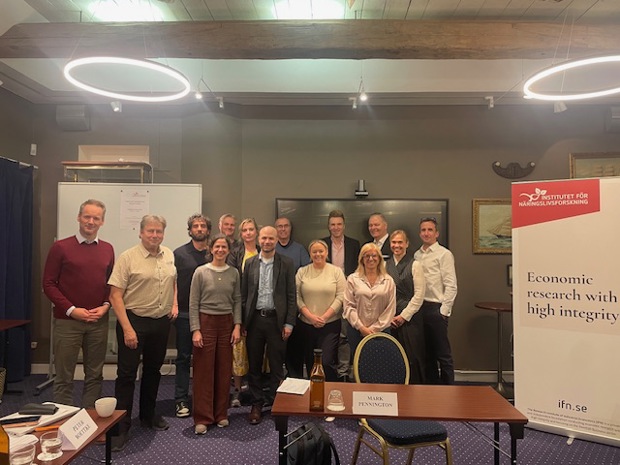
In May, 2026, 14 scholars got together in Stockholm to discuss human freedom. The basis of the discussion was a selection of readings on various themes, which the participants had read beforehand. The themes ranged from how to understand the concept of freedom to studies and ideas about what brings about and undermines freedom, as well as what its consequences are.
Within the research project Human Freedom: Emergence and Payoffs, financed by the John Templeton Foundation (grant 63522) and the Research Institute of Industrial Economics (IFN), Niclas Berggren and Christian Bjørnskov organized a colloquium on the causes and consequences of human freedom in Stockholm on May 14–17, 2026. The purpose of the colloquium was to help the organizers and other participants deepen their understanding of what freedom is and how it can be studied fruitfully in innovative social-science research.
For details about the colloquium, see its web page. The colloquium was attended by 14 scholars from different disciplines who, under the leadership of Mark Pennington, discussed a selection of texts organized into six sessions. Below is a brief summary of the discussions of each session.
Session I: Freedom in History
The first session examined competing understandings of freedom and the historical conditions needed to preserve it. Drawing on texts by Acton, Constant, and Hayek, participants discussed freedom as a fragile achievement that depends on both individual autonomy and institutional restraint. Democracy was discussed from different perspectives: it can protect citizens from domination, but majorities can also threaten minority rights or future generations. Hayek's distinction between true and false individualism led to discussion of the Swedish welfare state, responsibility, and dependence. The session also emphasized that formal institutions require deeper cultural supports, including trust, civic norms, religion, and shared moral commitments.
Session II: The Meaning of Freedom
The second session focused on the language of freedom, rights, and coercion. Berlin's distinction between negative and positive liberty framed much of the discussion, especially the danger of redefining restrictions on freedom as freedom itself. De Jasay's critique of rights inflation raised questions about whether positive rights impose costs and obligations on others. Participants also discussed the Universal Declaration of Human Rights and the measurement of economic freedom. Public choice theory was seen as useful for understanding democracy, but some participants stressed that politics differs from markets because political outcomes are imposed collectively and governments possess coercive authority.
Session III: Economic and Political Freedom
The third session explored the relationship between economic and political freedom. Friedman and Hayek prompted debate about whether economic freedom is necessary for political liberty and whether planning is compatible with democratic pluralism. Participants contrasted fears of state power with contemporary concerns about private wealth concentration, lobbying, and rent-seeking. Modern interventionism was distinguished from older forms of socialism: today, planning often appears through climate policy, industrial strategy, housing regulation, or market steering. The discussion also addressed COVID-19 restrictions, debt, freedom of speech, digital platforms, and whether democratic institutions remain resilient enough to correct policy failures.
Session IV: Economic Freedom, Culture, and Morality
The fourth session examined the moral and cultural foundations of economic freedom. Participants discussed whether religious traditions, especially Protestantism, historically supported trust, literacy, markets, and economic development, while also questioning whether theology itself was the causal factor. Choi and Storr's work on markets and morality led to debate about whether markets encourage prosocial behavior or moral corruption. Participants stressed that markets depend on trust, property rights, and expectations of fair dealing. Cowen's discussion of social justice shifted attention from static redistribution to innovation, capital creation, opportunity, and the long-run effects of economic freedom.
Session V: Personal Freedom
The fifth session considered personal freedom, happiness, and self-realization. Participants debated whether freedom should be understood as an objective institutional condition, a subjective experience, or a process of self-creation and meaningful identity formation. The idea that happiness may depend on "daring to be free" generated discussion about the burdens of responsibility, choice, and social acceptance. Nozick's framework for utopia and Pennington's critique of paternalistic positive rights highlighted the importance of pluralism, decentralization, and exit. The session ended with reflections on artificial intelligence, work, esteem, and whether technological abundance could change how personal freedom is experienced.
Session VI: Limits of Freedom
The final session examined paternalism, collective purpose, market limits and freedom of speech. Buchanan's argument that people may be "afraid to be free" led to discussion of welfare states, religion, dependency, and the demand for protection. Mazzucato and Satz prompted debate about when markets should be shaped by public authority and whether governments possess the knowledge to pursue collective goals. Participants also discussed hate speech and hate crime legislation, distinguishing harmful conduct from the regulation of beliefs or motives. The session highlighted the central liberal challenge: preserving freedom while responding to demands for security, moral order, and social cohesion.
Concluding Remarks
The sessions suggested that freedom depends on more than formal rights or market institutions. It requires dispersed power, trustworthy institutions, civic responsibility and openness to disagreement. The colloquium clarified both the value of freedom and the conditions under which it can be sustained. Further insights will emerge in future work in the research project.