
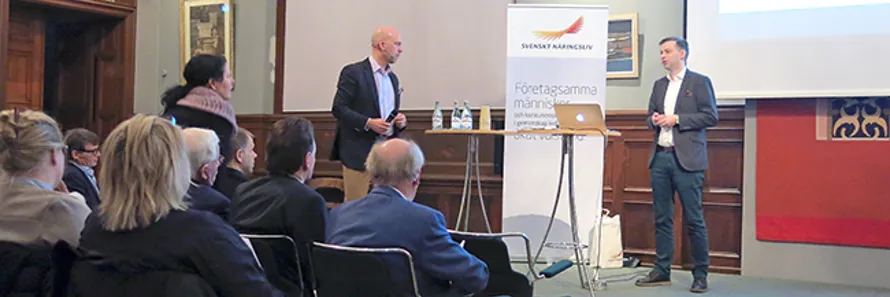
A criticism regarding for-profit enterprises in the welfare sector is that these firms have inferior quality of services − in order to make more money. "That's not true," said Henrik Jordahl. "If anything, the most profitable companies have higher quality."
Henrik Jordahl showed that the economic consequences of the Reepalu-proposal would be:
- Increased costs
- Fewer start-ups
- Reduced investments
- Lower productivity
- Future threats to the quality of welfare services
- Impaired freedom of choice
Read the report
A second report was presented: "Avkastning på bokfört operativt kapital i välfärdsbolag" ("Return on operating capital of firms in the welfare sector," PwC). Two separate discussions followed, both moderated by Robert Thorburn, Confederation of Swedish Enterprise:
What does Reepalu’s suggestions entail and what’s up for your company?
Professor Pär Strömberg, Stockholm School of Economics discussed with Peter Nyllinge, CEO of PWC.
How will the Reepalu-commission's suggestions impact the Swedish welfare model?
The panel consisted of: Lars Stjernkvist, Mayor of Norrköping (S), Maria Arnholm, Party Secretary (L), Matz Nilsson, Chairman of Sveriges Skolledarförbund (The Swedish Association of School Principals and Directors of Education ), and Anders Morin, Confederation of Swedish Enterprise.